
In this entry 4 sections
“Done” is a useful word at work. It closes a task, moves a card, ends a meeting, and announces a release.
It can also hide a transfer of work.
The part assigned to me may be finished while someone else is still trying to understand what changed, why it changed, or what they are supposed to do next. That makes completion a little more complicated than checking off my own task.
When I call something finished, who still has work to do because of how I left it?
Someone else inherits the ending
Consider a feature that ships successfully. The code works, the release goes out, and the team moves on. Then a customer asks support why something changed. The answer exists in a conversation that support was never part of.
Or a meeting ends with everyone nodding. A week later, two people remember different decisions. Nobody wrote down the owner or the next step, so the same discussion starts again.
Neither situation requires bad intentions. Each can happen when people are busy and reasonably focused on their own part. Yet the missing context becomes real work for someone else: finding a person, reconstructing a decision, asking a customer to wait.
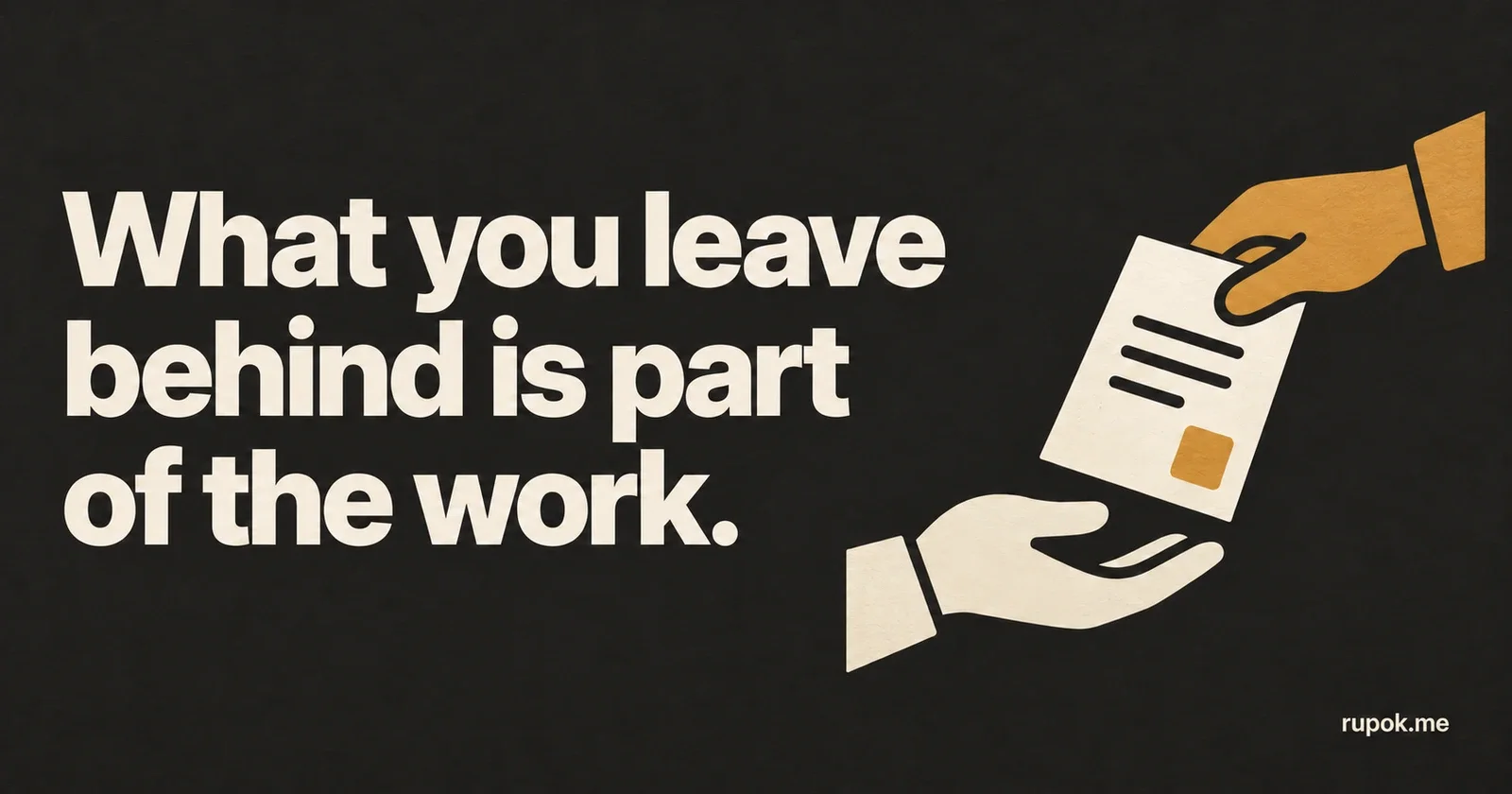
That is the part of completion I want to pay more attention to. Work travels through other people’s hands. The condition in which we pass it on affects how much they can do with it.
Make the handoff part of the task
A useful handoff can be very short. Often a few clear sentences are enough:
- What changed? Describe the result and where to find it.
- Why does it work this way? Record the decision someone is likely to question later.
- What remains open? Make the uncertainty visible.
- Who takes the next step? Name the owner and what they need to do.
For a release, that might be a note explaining a behavior change and a known limitation. For a support escalation, it might be the customer’s goal, the steps already tried, and the evidence that will help an engineer investigate. For a meeting, it might be one paragraph with the decision and a date.
The aim is to give the next person a useful starting point. They should not have to repeat the work of understanding what just happened.
This also puts a sensible boundary around finishing. Every project has loose ends. You can leave a question unresolved while still leaving it clearly described, with an agreed owner. That is a much better handoff than a confident “all done” that hides the remaining work.
A good finish makes someone else's next step easier.
Notice who absorbs the cleanup
There is a leadership responsibility here too.
If a team celebrates launches but gives no time or recognition to documentation, follow-through, or support preparation, people learn where to put their attention. The work that makes a launch sustainable gets squeezed into whatever time is left.
Often the most conscientious people quietly fill the gaps. They write the missing notes, check the unanswered question, and explain the decision again. It is easy to mistake their effort for a process that works.
I think leaders need to make that work visible and give it room in the plan. Ask what support needs before a release. Leave time to record a decision. Recognize the person whose careful handoff saved three colleagues from having to start over.
Shared care also needs shared responsibility. The same reliable person should not become the permanent destination for everyone else’s unfinished work.
A question to use on ourselves
I want to apply this standard to my own work first. A difficult handoff rarely tells the whole story about another person. Someone may be distracted, under pressure, or working without the time and context they needed themselves.
The useful question is what I can leave clearer, easier to find, or better prepared for the next person. Sometimes the answer is a note. Sometimes it is a thank-you. Sometimes it is admitting that something is still unfinished and agreeing on who will carry it forward.
Before closing the tab, leaving the meeting, or calling the project done, I want to ask: what will the next person need?
What we leave behind is part of the work they receive.

Founder and CEO of Startise. I write about building products and companies, and about software for AI agents.